Worked Investigation: What an Estate Inventory Can Actually Tell You
Follow Fairfax County's real will-book index to an inventory request, then practice interpreting a clearly fictional appraisal without inventing heirs, occupations, or net wealth.
An estate inventory can make a distant life feel tangible: tools, livestock, furniture, and other possessions appear together on a page. That immediacy is useful, but it can tempt us to supply a story the record never tells. This investigation shows how to find the relevant record and distinguish an observation from an inference.
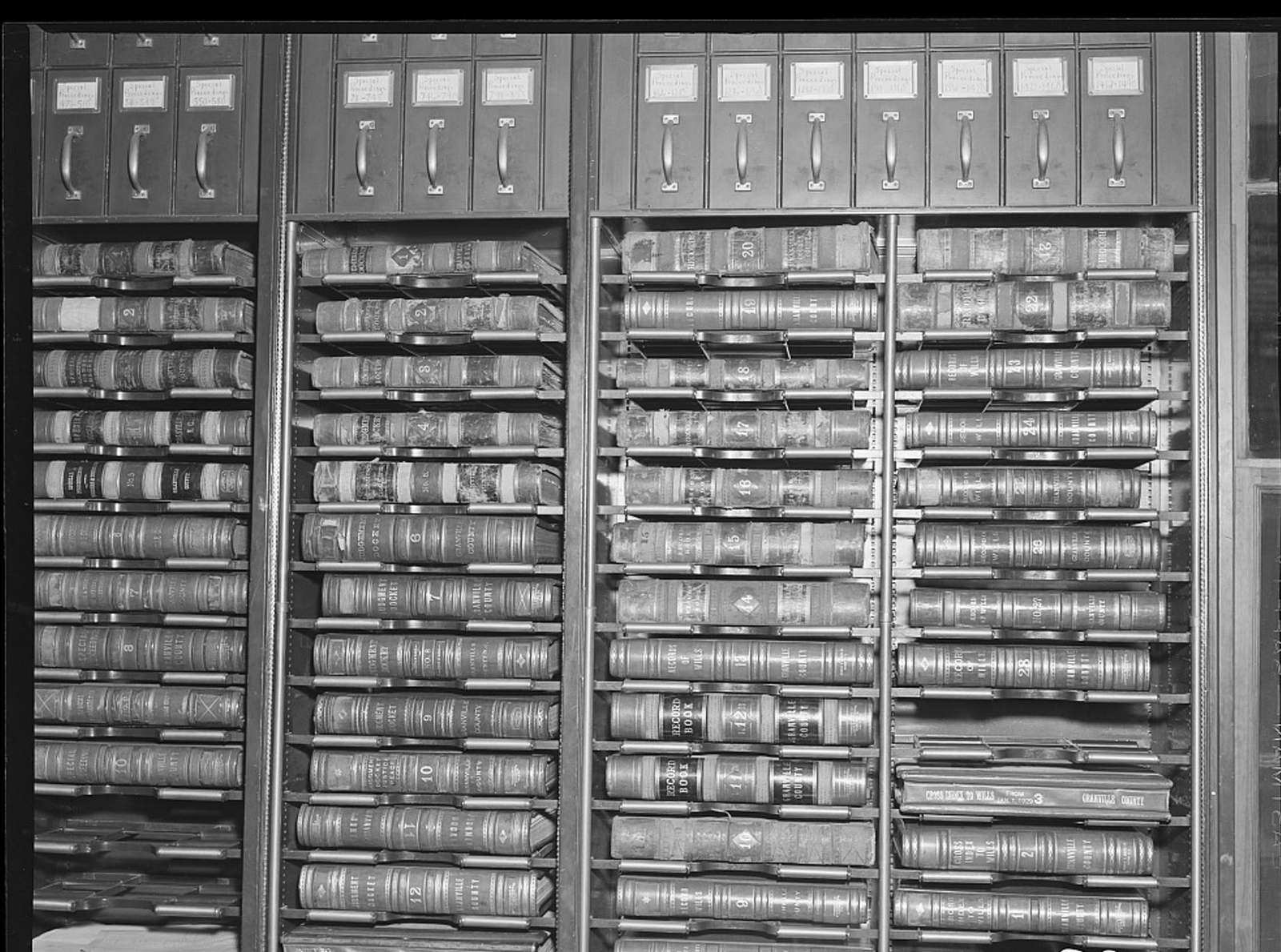
About this example: Fairfax County's holdings and the Adaline Adams index references below are real. We have examined the index, not those underlying estate documents. Morgan Sample and all names, property, dates, and values in the teaching diagram are fictional. The diagram is not a reconstruction of the Adams estate.
1. Begin with the question, not the possessions
Our exercise asks: “What does an inventory reveal about the property being appraised, and what other records would establish the family relationships?” Those are related questions, but the same document may not answer both. Start by writing down which person and locality you are investigating and the evidence connecting that person to the place.
Review Wills and Probate for the different documents an administration can produce. A will records instructions; an inventory describes property; a sale account concerns sales; an estate account records financial administration. Their contents and survival vary. Do not treat them as interchangeable copies of the same information.
2. Follow the county inventory to the holder
Our Fairfax County inventory lists will books and indexes among its surviving records. Its spans describe the source inventory, not every record held by every repository. The county's Historic Records Center wills guide describes its will books for 1742–1936 and explains that they contain inventories, estate and sale accounts, and several kinds of bonds as well as wills.
On that official page, open the A–K will-book index. On its first page, Adaline Adams has an administrator bond listed in book G 2, page 416, for 1895; an inventory and appraisal at G 2, page 425, for 1896; a sale account at G 2, page 426, for 1896; and an estate account at G 2, page 548, for 1897. These are actual index references. They demonstrate why searching only for a document labeled “will” can miss a useful sequence.
The index is a finding aid. Those entries do not tell us what Adaline owned or who her relatives were. To learn that, use the guide's copy-request instructions and ask for the specific documents, including continuation pages. Confirm current access and copying arrangements with the holder. A request that includes the name, document type, book, and page is easier to act on than “Please send everything on my family.”
3. Identify what kind of document you received
Reading an estate inventory — fictional teaching example
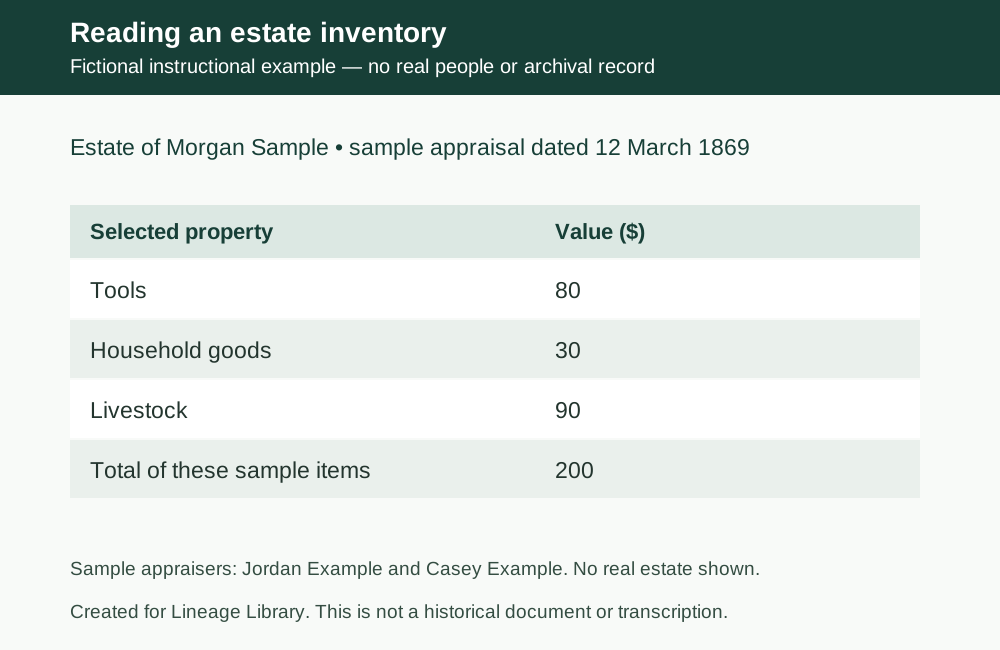
Select a number to outline that part of the page.Select a note below to outline that part of the page. Open the full page
- An appraisal date records that action. It is not automatically the person’s death date.
- Tools invite questions about work. This shortened description does not prove a particular occupation.
- These invented values total $200. An appraisal is not a sale account, and this extract is not net wealth.
- Look for the will, bonds, sale account and settlement where available. Appraisers are not automatically heirs.
Now leave the real Adams index behind and work only with the invented Morgan Sample exercise. The modern diagram shows an appraisal dated 12 March 1869. It lists tools valued at $80, household goods at $30, and livestock at $90, totaling $200 for those sample items. The arithmetic is straightforward; the historical interpretation requires more care.
The Fairfax guide distinguishes an inventory of personal property from an appraisal that assigns monetary values. Check what the actual document calls itself and what its heading says. Identify the estate, appraisers, date, and any statement about when the document was returned or recorded. These may be different dates, and none should silently become the decedent's death date.
4. Separate observations from stories
“Tools appear in the sample appraisal” is an observation. “Morgan was a blacksmith” would be an unsupported conclusion because the diagram does not name the tools or an occupation. Even a detailed list needs context. An item might belong to a household business or have been used by someone other than the person whose estate was administered.
Likewise, $200 is the total of our invented displayed items. It is not a statement of net wealth. An appraisal is not a record of sale proceeds, and this simplified example says nothing about debts, expenses, omitted property, or land. Avoid turning a partial valuation into a comparison of how rich two families were.
Historical inventories may include people subjected to enslavement, described under the property system of that time. Preserve their names and identifying details with care, and seek records documenting their own lives and relationships. Our fictional postwar table does not model that part of earlier probate research.
5. Read people according to their stated roles
The sample appraisers are Jordan Example and Casey Example. Their role is appraisal; the diagram does not make them children, siblings, or heirs. If another document named Avery Sample as administrator, a shared surname would still not establish a specific relationship. Record “administrator” first and investigate kinship separately.
Sale purchasers can provide leads too, but a buyer is not automatically a relative. A familiar household object bought by someone with the same surname may be suggestive; it remains an inference until supported. The FAN Club approach helps organize these associations while retaining the difference between a documented role and a proposed family link.
When handwriting is difficult, make a careful transcription before building a story around an item or name. Keep doubtful readings visible, using the method in Reading Old Handwriting. An uncertain surname should not become a certain connection merely because you entered it into a tree.
6. Decide what to obtain next
For the real Adaline Adams references, the useful next action is retrieving the indexed documents. For our fictional Morgan Sample exercise, the next action depends on the question: an account could clarify administration, a sale account could show recorded purchasers and proceeds, and other estate or court records might state relationships. Availability must be checked locally.
A defensible exercise conclusion is: “The sample appraisal lists selected personal property with a combined appraised value of $200. It does not establish Morgan's occupation, heirs, net wealth, or exact death date.” That is useful knowledge, even though it leaves questions open. Keep the inventory citation separate from the citations for any later documents that answer them.
Try this: locate one real probate index entry and write a precise request for its underlying document. When you read it, list three direct observations, two possible interpretations, and one record that could test each interpretation.