Worked Investigation: From a Deed Index to a Researchable Land Trail
Use the Adams County, Pennsylvania, inventory to locate the right index and deed series, then practice interpreting an explicitly fictional entry without mistaking an index for proof.
A deed index can turn a common surname into a precise book-and-page reference. It can also mislead if you stop there. This investigation follows the route from a real county inventory to a document request, then uses invented entries to show what the index does and does not establish.
About this example: the Adams County inventory and Pennsylvania State Archives series listed below are real. Thomas Example, Ruth Sample, the index entries, the deed wording, and every resulting inference in the exercise are fictional. The teaching diagram is not a scan or transcription of an Adams County record.
1. Ask a question the records can answer
Our fictional question is: “Which deed records Thomas Example receiving land, and can that document help distinguish him from another person of the same name?” We are not yet asking who his parents were. Keeping the immediate question narrow makes it easier to recognize what a useful record must contain.
Start a log with the name variants, approximate period, and jurisdiction you will search. Include what made you associate the person with that county. A family tree's unsourced place label is a clue to test, not a reason to ignore neighboring counties or an earlier jurisdiction.
2. Find both the index and the document series
Our Adams County inventory leads to the Pennsylvania State Archives' Record Group 47 county microfilm listing. Under Adams County's Recorder of Deeds, that official finding aid lists deeds for 1800–1851, a grantee index for 1800–1937, and a grantor index for 1800–1937. The differing date ranges matter: finding a later index entry does not establish that the corresponding deed is included in that same listed copy series.
For a question around 1815, both the indexes and the listed deeds span the period. Record their exact titles. Follow the archive's current catalog and access instructions, or ask its reference staff how to consult the digitized microfilm. The finding aid says staff cannot provide research or copies from these records. Do not assume that a page displaying a series title is itself a name-search database.
The listing also states that Adams County was created from York County in 1800. For an earlier transaction, investigate the relevant York records and the historical location of the land. A later county boundary does not move an earlier recording into a new volume automatically.
3. Read the index in the right direction
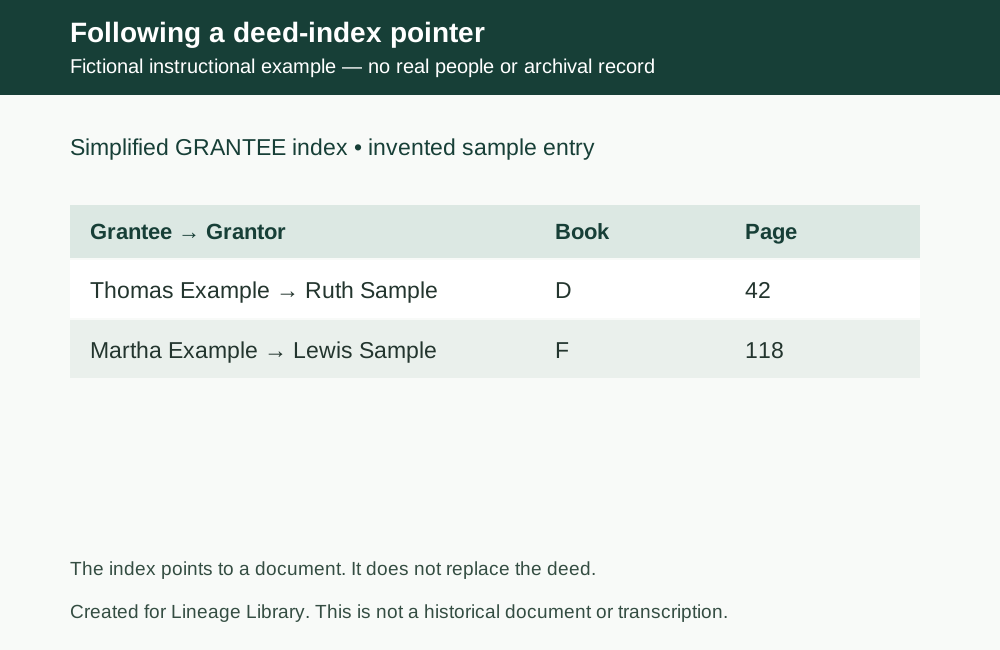
Following a deed-index pointer — fictional teaching example
Select a number to outline that part of the page.Select a note below to outline that part of the page. Open the full page
- This invented grantee index is searched under the receiving party. Also search the granting party’s index.
- Capture both names exactly. Their roles and relationship must be checked in the document itself.
- Book D, page 42 is the invented locator. Page 42 without its book is incomplete; image numbers may differ.
- Another matching surname is a separate lead. Do not merge people before comparing the actual instruments.
In this fictional grantee index, Thomas Example is the receiving party and Ruth Sample is the granting party. The pointer is book D, page 42. Preserve all three pieces together: names, book, and page. If an actual index includes dates, instrument types, township, or remarks, copy those too.
For an ordinary purchase, the grantee is the buyer and the grantor is the seller. However, recording offices handle other instruments as well. The index labels alone do not prove that cash changed hands or that the instrument conveyed the whole property outright. Read the document's title and operative language. The Land Records guide introduces the distinction between a first government grant and later transactions.
Search both directions. A person may be easier to identify in a later conveyance than in the acquisition. Also read the index's own instructions: arrangements and cross-references differ. A surname section can subdivide names in ways that make a quick alphabetical skim incomplete.
4. Open the deed, including its ending
Imagine that our invented deed at D:42 was signed on 4 November 1812 but recorded on 20 February 1815. Those are two events, not competing versions of one date. The recording date does not by itself establish when Thomas first lived there. In a real document, distinguish execution, acknowledgment, and recording dates wherever they appear.
Suppose the fictional wording calls Thomas “of Pine Township” and describes 40 acres adjoining a named creek. That adds a residence statement and a property description to investigate. Neither alone proves his birth, his parentage, or that he lived on those particular acres. The residence and the land's location should have separate fields in your notes.
Capture the entire instrument and its recording statement, including continuation pages. Note all parties, their stated roles, the description, consideration, witnesses, acknowledgments, and references to earlier deeds. If a word is uncertain, mark it as uncertain instead of silently replacing it with the name you hoped to find. Use Reading Old Handwriting for a systematic transcription method.
5. Follow the property while testing the person
A land description can provide continuity when personal names are common. Follow any earlier book-and-page reference, then look for later transfers involving the same tract. Compare acreage, adjoining owners, waterways, and the description as a whole. Similar acreage alone is not enough: many unrelated tracts can contain 40 acres.
Our next fictional finding might be a later Thomas Example conveyance describing a different township and 80 acres. That does not automatically disprove identity; one person could own several properties. It does mean the new deed needs an independent connection. Keep it as a candidate rather than folding it into the first trail without explanation.
Likewise, a witness or adjoining owner may be useful in associated-person research. That person is not automatically a relative. Explain what each connection actually is: named witness, adjoining landholder, grantor, or grantee. A precise role is more useful than a vague statement that two people were “connected.”
6. End with a bounded conclusion
For this exercise, the fictional index supplies a locator, and the invented deed adds dates, a residence statement, and a tract description. We have a trail to test, not a proven parent-child relationship. A sound note would say: “The sample D:42 deed identifies a Thomas Example associated with Pine Township. His identity relative to the other same-name candidate remains to be established.”
For your real research, cite the county, recording office, series, book, page, parties, and dates, along with the repository or website and image identifier you used. Cite the index separately if you have seen only the index. That distinction allows another researcher to understand exactly what you examined.
Try this: select one real index entry and retrieve its document. Make a two-column note headed “What the index says” and “What the document adds.” Then identify one conclusion that neither source supports yet.