Worked Investigation: Are These Tax Entries the Same Person?
Follow a real Augusta County research route, then use a clearly fictional tax-list exercise to separate observations from assumptions about identity and movement.
A name appears on a tax list, disappears the next year, and returns somewhere else. Did your ancestor move? Before answering, you need to know which lists you searched, what their columns mean, and whether you have one person or two. This investigation shows how to turn a county inventory into a specific records request and a cautious research conclusion.
About this example: the Augusta County record inventory and Library of Virginia access route below are real. All people, entries, district labels, and results in the teaching exercise are invented. The diagram is a modern instructional table, not an archival scan or a transcription. It does not document an Augusta family.
1. Turn the question into a search plan
Our fictional question is: “Does the Thomas Example charged with two horses in 1815 represent the Thomas Example found in the previous year's list?” That is narrower than asking for his entire family. It also avoids beginning with an assumption that the two entries belong together. Review Tax Lists if the distinction between a taxpayer and a household is new to you.
Write down the details that would help distinguish candidates: locality, district, spelling, property categories, associated names, and any identifying words actually written beside the entry. Keep an empty space for contradictory evidence. A useful comparison does not quietly discard the entry that fails to fit your preferred explanation.
2. Follow a real county route
Open our Augusta County inventory. Its local-records tax section lists tithables for 1777. That listing is a starting point, not a declaration that no later tax records exist. It describes one inventory's holdings. A separate statewide tax collection can cover different years.
The Library of Virginia's Augusta personal property tax microfilm list identifies reel 25 for 1811–1820. That is the specific reel to investigate for an 1814–1816 question. The library's collection guide explains that microfilm can be viewed there and selected reels can be borrowed through interlibrary loan. Check the current borrowing instructions with your library; a reel's existence does not mean its images can be opened at home.
A focused request would say: “I am researching Augusta County personal property tax entries for 1814–1816. Your finding aid lists reel 25, covering 1811–1820. What is the current way to consult these years, and are there separate district lists?” Include the repository's answer in your log. You now have a record series, date window, reel number, and access question instead of a vague request to find an ancestor.
3. Read the headings before the surname
Reading a tax-list entry — fictional teaching example
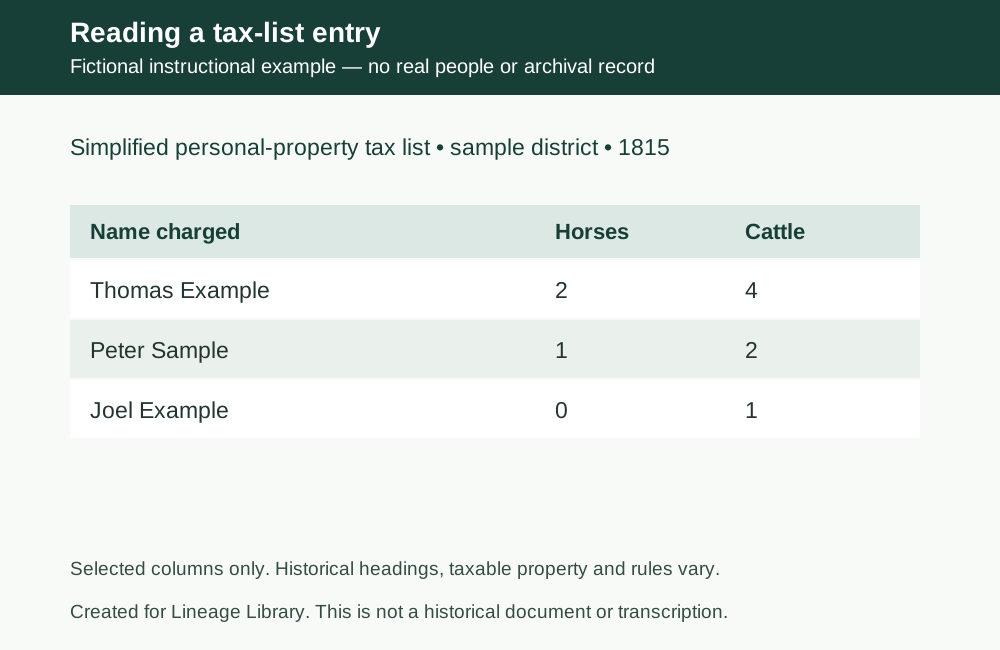
Select a number to outline that part of the page.Select a note below to outline that part of the page. Open the full page
- The year and district belong to the list, not to a person’s birth or arrival. Save the actual title and all headings.
- A named taxpayer is not a complete household list. A shared surname does not establish a relationship.
- Two means two horses in this invented row. It is not an age, a household count or acreage.
- People on nearby lines may be alphabetized. Page proximity alone does not establish physical neighbors.
The fictional table gives Thomas Example two horses and four cattle. Those figures describe only the displayed categories. They do not reveal his age, his children's names, his acreage, or the value of everything he owned. Our diagram intentionally omits other columns; a real researcher must preserve the actual full heading and determine which categories were taxed in that year.
Virginia tax records changed over time. The library's guide explains that personal property taxation included livestock and other property, and that enslaved people were also counted before 1865. Those historical records require reading the categories as written while recognizing that people subjected to enslavement were people, not property. Do not treat our simplified exercise as a complete historical form.
For each actual entry, save the title page or identifying heading, the entire page, and a legible detail if needed. Record the district, page or image identifier, and reel. An image number is a location within a digital sequence; it is not necessarily the original page number.
4. Compare competing explanations
Suppose our invented research log contains these observations:
- 1814, sample district A: Thomas Example, two horses and four cattle.
- 1815, sample district A: Thomas Example, two horses and four cattle, as shown above.
- 1815, sample district B: another Thomas Example, one horse and no cattle.
- 1816, sample district A: no matching entry found in the pages searched.
The repeated animal counts make the first two entries worth comparing, but matching quantities do not establish identity. The second 1815 entry creates a competing candidate. It could represent a different person; it could also require an explanation involving how the lists were compiled. Do not decide which without examining the original lists and their administrative context.
The 1816 search result is also limited. “Not found in these pages” is an observation about your search. “Moved away” is a proposed explanation. Death, changed responsibility for property, a name variant, omitted pages, or a different district might also explain the result. Check the coverage before using absence as evidence. See The Genealogical Proof Standard for a framework for evaluating the evidence.
5. Choose a record that can test identity
The next search should add something the tax list cannot supply. A deed might distinguish residence or identify a tract. An estate record might explain a change in who was assessed. A court entry might describe an occupation or relationship. Choose the record that addresses the uncertainty rather than collecting more occurrences of the same name.
Track associated people with the FAN Club method, but inspect the list's arrangement first. Adjacent lines can reflect alphabetical sorting, not neighboring homes. If Thomas appears beside Joel Example, the shared surname is a lead to investigate, not proof of a father-son relationship.
Our defensible fictional conclusion is: “The 1814 and 1815 entries in sample district A may concern the same person. A second same-name entry exists in district B. Identity and the reason for the 1816 absence remain unresolved.” That statement preserves the useful finding without manufacturing a migration or a family connection.
Try this: choose three surviving tax years for one locality. List every plausible same-name entry, record exactly which districts and pages you checked, and write one alternative explanation for each apparent change. Finish by naming the independent record you will consult next.